
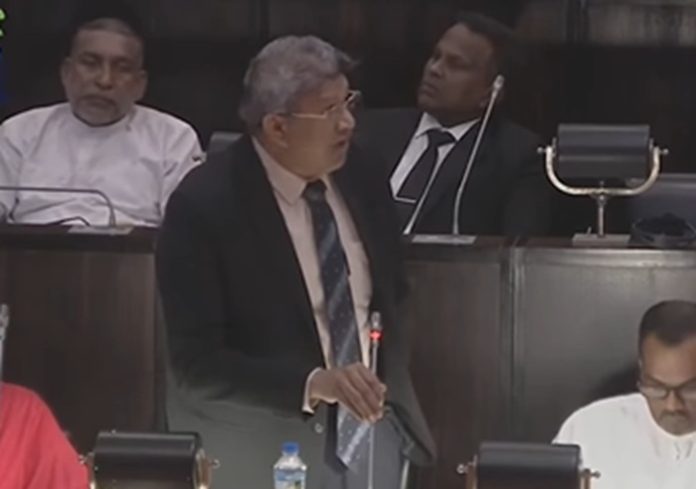


Justice Minister Harshana Nanayakkara told Parliament on Monday that the recent violence at Negombo Prison claimed 27 lives, including seven prison officers and 20 inmates, while 57 others—three prison officers and 54 inmates—remain hospitalised with injuries.
Making a special statement in Parliament, the Minister described the incident as a tragedy that should never have occurred and extended his condolences to the families of those who died.
Nanayakkara said the unrest was not a confrontation between prison staff and inmates, but a violent clash between two rival groups of prisoners linked to organised crime and drug trafficking.
According to the Minister, the initial violence broke out on July 5 at around 11 a.m., leaving two inmates dead and 35 others injured. Although prison authorities managed to temporarily restore order that evening, fresh violence erupted on the morning of July 6 as inmates were being prepared for court appearances.
He alleged that inmates who had been providing prison authorities with information on drug smuggling operations were among the first targets of the attack. During the violence, organised groups also destroyed CCTV cameras and high-value body scanners worth millions of rupees in what he described as a deliberate attempt to disable the prison’s narcotics detection system.
The Minister said prison officers came under attack with bricks and poles while attempting to rescue unarmed colleagues trapped inside the prison. He paid tribute to officers who lost their lives while carrying out their duties.
As the situation deteriorated, inmates broke through several security barriers and were approaching the prison’s outer exit when security forces opened fire to prevent a larger security breach. While some deaths have been confirmed as resulting from gunfire, Nanayakkara said post-mortem examinations are continuing to determine whether other fatalities were caused by assaults between inmates.
Following the violence, 734 inmates believed to have been involved in the unrest were transferred under heavy security to other prisons across the country.
The Minister said multiple investigations have been launched into the incident. A Presidential Committee headed by retired judge Priyantha Fernando, alongside President’s Counsel Moha Weerakoon and senior public official Milinda Gunaka, has been appointed to examine the circumstances surrounding the incident and identify security lapses. Meanwhile, the Criminal Investigation Department is conducting a criminal investigation, while the Department of Prisons has commenced an internal disciplinary inquiry.
Nanayakkara also pointed to longstanding structural issues within the prison system, noting that Sri Lanka’s prisons currently house between 27,000 and 29,000 inmates despite having a capacity for only around 10,000.
He said amendments to drug-related laws introduced in 2022 had contributed to lengthy delays in granting bail, leaving many suspects in remand custody for up to one-and-a-half years before their cases were heard.
To address overcrowding, the Minister said the Government is preparing legislative amendments to allow courts to consider the gross weight, rather than the pure weight, of seized narcotics when determining bail eligibility. He said this is expected to expedite court proceedings and reduce the remand population.
The Government is also working to fill more than 1,300 vacancies in the prison service, with 401 officers already recruited. In addition, the Minister proposed increasing the retirement age of experienced prison and legal officers beyond 60 to retain institutional expertise.
Among other reforms under consideration are legislation to introduce house arrest as an alternative sentence and the use of electronic monitoring to reduce pressure on the prison system.
Nanayakkara assured Parliament that the Government would implement the necessary legal, administrative and security reforms to prevent a similar tragedy from occurring again.