
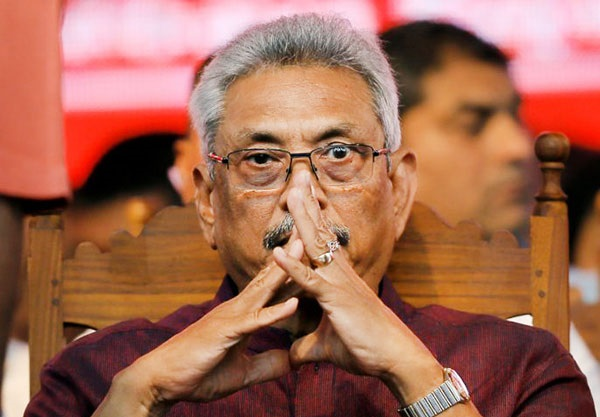

The Criminal Investigation Department (CID) opposed a request by former President Gotabaya Rajapaksa to temporarily lift his overseas travel ban for a medical examination in Singapore, unless a mechanism could be established to ensure his return.
The Fort Magistrate’s Court considered the application on 4 November. Rajapaksa, who sought permission to visit Mount Elizabeth Hospital, was also present in court.
Making submissions for the prosecution, CID officers said investigations were continuing into former State Intelligence Service Director Suresh Sallay, the third suspect in the case relating to the Easter Sunday terrorist attacks.
“Your Honour, investigations are underway into Suresh Sallay, the former Director of the State Intelligence Service, who is the third suspect in this case concerning the Easter Sunday terrorist attacks. Travel bans were obtained against former President Gotabaya Rajapaksa, former Army Colonel Mohamed Ansar and former intelligence officer Premananda Udalagama because there was reasonable suspicion that they had indirectly assisted him.
“This is a highly sensitive and complex investigation. If he does not return to the country, it could seriously prejudice the investigations. Therefore, the prosecution has no objection to temporarily lifting the travel ban only if the court has a mechanism to ensure his return to Sri Lanka.”
Fort Magistrate Pasan Amarasena then asked whether Rajapaksa had been named as a suspect in the case. CID officers replied that he had not.
Responding, the Magistrate said the court could not impose bail conditions or require a bond from someone who had not been named as a suspect.
“The court cannot impose bail conditions or require bonds from a person who is not a suspect. Therefore, the court cannot establish a mechanism to ensure his return in the manner you suggest. State whether he is a suspect or not. Alternatively, if his failure to return could pose a serious threat, as you say, state that you oppose this application.
“The court cannot impose conditions on someone who is not a suspect. If the prosecution does not object to this application, the only action the court can take is to lift the travel ban.”
Investigators subsequently informed the court that the prosecution fully opposed lifting the ban if there was no mechanism to ensure Rajapaksa’s return.
Attorney-at-Law Ruwantha Cooray, appearing for Rajapaksa on the instructions of Attorney-at-Law Sarath Wijewardena, said his client required follow-up care after undergoing bypass surgery in Singapore.
“Your Honour, the applicant, Gotabaya Rajapaksa, underwent bypass surgery at Mount Elizabeth Hospital in Singapore in May 2019. Following that, he is required to travel to Singapore every six months for medical reviews and follow-up examinations. He has previously travelled for this purpose and returned to the country.
“The doctor who performed the surgery will be in Singapore only from 28 November to 8 December. If he cannot travel during that period, he will be unable to undergo the medical review for another year.
“He has not been named as a suspect in this case, nor has he been summoned to give a statement to date. We are only requesting that the travel ban be temporarily lifted for the specified dates. If necessary, the ban can be imposed again after his return.”
After considering the submissions, Magistrate Amarasena reserved his order on the application.
The Fort Magistrate’s Court imposed the travel ban on Rajapaksa on 3 June following a CID request in connection with the case against three people, including retired Major General Sallay, over allegedly misleading investigations into the Easter Sunday terrorist attacks.
Editor’s note: The supplied text gives 2 November as the date for the order, although the hearing took place on 4 November. The date requires clarification before publication.