
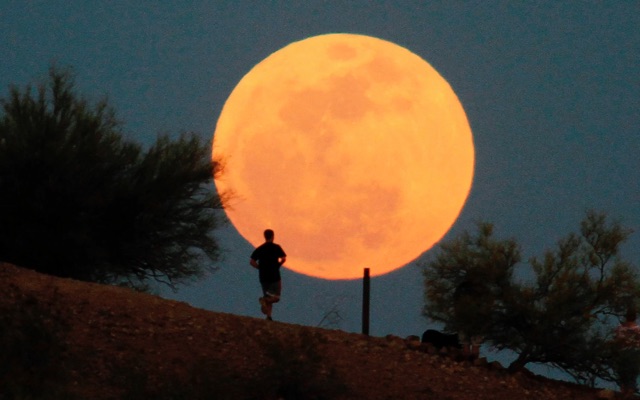

Sri Lankans were expected to witness a rare celestial spectacle on the night of November 24, with the Moon appearing larger and brighter than usual, according to astronomer Gihan Weerasekara.
Weerasekara said the phenomenon, commonly known as a supermoon, occurs when the Moon moves closer to Earth along its elliptical orbit, making it appear larger and more luminous than an ordinary full moon.
He explained that the Moon orbits Earth at an average distance of approximately 384,000 kilometres. However, because its orbit is elliptical rather than perfectly circular, the distance between Earth and the Moon varies throughout the month.
According to Weerasekara, the Moon was expected to move to within approximately 360,000 kilometres of Earth on November 24, bringing it around 25,000 kilometres closer than its average distance.
As a result, the Moon was expected to appear approximately 6.5% larger in diameter and 14% brighter than a typical full moon, he said.
Weerasekara noted that the phenomenon would be visible to people across Sri Lanka, provided weather conditions remained favourable and the night sky was clear.
The November full moon is also traditionally known in several Western countries as the Beaver Moon, a name associated with the seasonal behaviour of beavers in the Northern Hemisphere.
During this period, beavers become particularly active in building their shelters and storing food in preparation for winter, before lakes and other bodies of water begin to freeze.
Explaining the astronomical phenomenon, Weerasekara said the Moon’s elliptical orbit periodically brings it closer to Earth, producing the visual effect associated with a supermoon.
He added that the reduced distance would make the Moon appear noticeably larger and brighter to observers, offering an opportunity for astronomy enthusiasts and the general public to witness the spectacle.