


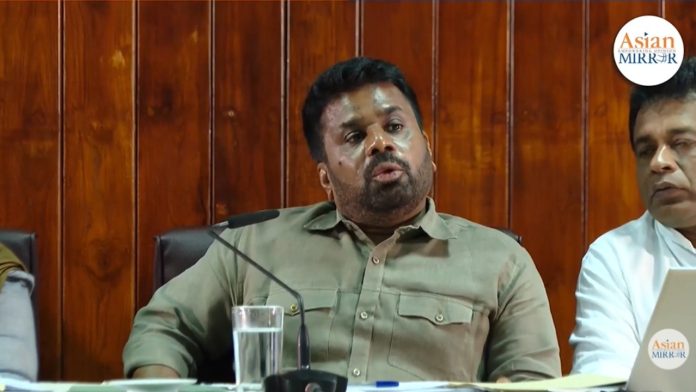

Irrigation Department officials have defended their handling of water releases from the Kotmale reservoir during last week’s extreme weather and announced major administrative changes to prevent future flooding in Nuwara Eliya.
During a detailed briefing to President Anura Kumara Dissanayake during Nuwara Eliya District Coordination Committee, officials clarified that the Kotmale reservoir recorded an unprecedented inflow of 2,720 cubic metres per second on 27 December, forcing engineers to open the spill gates to protect the dam’s structural integrity. Although water levels dropped sufficiently for the gates to be closed on the morning of 28 december, a renewed rise in inflow later that evening required a second controlled release.
Officials rejected allegations that the spill gates were opened suddenly or without proper safety measures. They stressed that releases were carried out gradually, noting that delaying the operation until the reservoir was full would have required opening the gates much wider, leading to far greater downstream damage.
Responding to questions about public warnings, officials said a siren is sounded 10 minutes before the gates are opened to alert people bathing or fishing in the river. When the President asked whether a 30-minute or one-hour warning could be implemented, they responded that this was not feasible due to rapid and unpredictable changes in inflow and power station operations.
The briefing also addressed the flash floods that inundated Nuwara Eliya city. Officials attributed the severity of the flooding to long-term neglect, blocked canals and unauthorised constructions, compounded by the technical limitation of the lake’s existing 1.5-foot sluice gates, which are too small to release water quickly during extreme rainfall.
As part of the proposed reforms, the technical management of the Nuwara Eliya Lake—currently under the Municipal Council—will be transferred to the Irrigation Department. Officials said the Council lacks the engineering capacity required for proper maintenance. Under the new arrangement, the Municipal Council will retain control of all economic activities and revenue generated from the lake, while the Irrigation Department will take over engineering and hydrological management.