
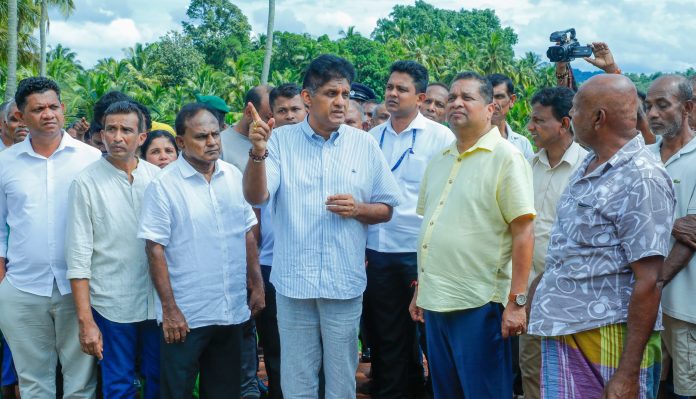

Opposition Leader Sajith Premadasa has proposed the establishment of a dedicated Cabinet Ministry for disaster management, warning that Sri Lanka lacks an effective, coordinated and institutionalised mechanism to respond to natural disasters.
Addressing the media during a visit to landslide-affected villages in Ibbagamuwa of the Kurunegala district, Premadasa said the country does not have a clear, efficient or results-driven disaster management framework. He argued that the disaster management sector itself has become a “victim of a disaster” due to the absence of defined institutions, guidelines, operational structures and a clear roadmap.
He stressed that key agencies dealing with landslides, floods and extreme weather events — including the National Building Research Organisation (NBRO) and the Geological Survey and Mines Bureau (GSMB) — are not operating within a properly coordinated national plan. Premadasa said Sri Lanka urgently needs an integrated disaster management strategy that is implemented centrally as well as at district, divisional and Grama Niladhari levels.
“This subject must be elevated to a separate Cabinet Ministry if the country is to respond effectively to disasters and minimise loss of life and property,” he said.
During the visit, the Opposition Leader inspected the landslide site in the Pudukulam area of the Hiriyala electorate and later visited displaced residents currently sheltering at the Panliyadda Viharaya in the Omaragolla and Godaparagolla areas, where he listened to their concerns.
Premadasa also called for the deployment of a specially trained, grassroots-level disaster management officer system and urged authorities to learn from repeated tragedies to rebuild what he described as a weakened national disaster response mechanism.
He further noted that, despite 21 years having passed since the 2004 tsunami, Sri Lanka has still failed to install the Doppler radar system in Puttalam, despite the foundation stone having been laid. He said he would urge the Japanese government to assist in expediting the installation of the system, emphasising that the proposal was being made in the collective interest of the public.