

Sri Lankan health authorities have moved to amend a decades-old regulation related to sterilisation procedures, citing the need to uphold human rights.
Accordingly, the long-standing requirement that a spouse’s signature be obtained on the consent form for sterilisation has been removed.
The revision was made through a circular issued in July this year by Director General of Health Services Asela Gunawardena, amending the existing administrative requirement to obtain spousal consent.
Under an amendment introduced in 1983, the prevailing regulation had made it mandatory for the spouse to sign the consent declaration for a sterilisation procedure. However, the Technical Advisory Committee on Maternal Health and Family Planning, which met in April 2022, concluded that this requirement should be revised.
The circular further notes that the Attorney General has confirmed that, under Sri Lankan law, neither men nor women are legally required to obtain a spouse’s consent to undergo sterilisation procedures.
Health officials have pointed out that the spousal signature requirement stemmed from an administrative circular used in government hospitals and institutions, rather than from statutory law. They stressed that internationally, medical procedures generally require only the informed consent of the individual undergoing surgery.
Officials explained that any person capable of understanding the nature of a surgical procedure may consent to it independently, unless the patient is a minor or lacks the mental capacity to provide informed consent. The sterilisation consent requirement was an exception to this principle, prompting authorities to revise the policy in line with accepted medical and ethical standards.
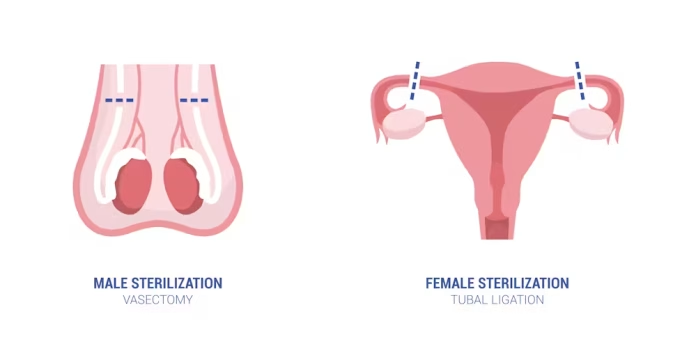
It is noted that sterilisation procedures performed in the country are predominantly female.