
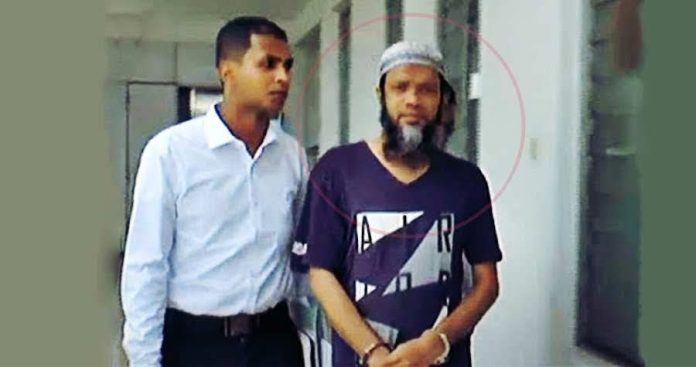

The 24 accused facing 23,270 charges, including conspiracy and aiding and abetting in connection with the Easter Sunday terror attacks, began presenting their defence statements from the dock before the Colombo three-judge High Court Trial-at-Bar on Monday (17).
The first accused in the case, Mohamed Ibrahim Mohamed Naufer, alias Naufer Maulavi, delivered his statement from the dock for nearly two hours, denying the allegations against him and maintaining that he had no involvement in the April 21, 2019 attacks.
The case is being heard before a three-judge bench comprising Justices Navaratne Marasinghe, Ramanathan Kannan and Sujeewa Nissanka.
The prosecution concluded presenting its evidence last week, following which the court had fixed August 17 for the accused to begin making statements from the dock and presenting evidence for the defence.
Presenting his defence, Naufer said he had been accused of acting together with nine individuals, including Zahran Hashim, Wasthun, Insaf and Ilham, to undermine national unity and promote extremism and terrorism. He said he also faced allegations of delivering extremist and terrorist lectures aimed at disrupting ethnic unity and reconciliation.
“I face 940 charges in relation to these alleged activities. I reject all of these charges,” he told court.
Naufer said he was arrested by police in Dambulla on the evening of the Easter Sunday attacks while travelling from Kekunagolla to his wife’s residence in Kattankudy.
He said he was subsequently handed over to the Criminal Investigation Department (CID) and detained there under detention orders for about one-and-a-half years.
“CID officers recorded several statements from me. The CID has a strange way of recording statements. First, they record the statement and later obtain signatures on documents containing the printed statements,” he alleged.
Naufer further alleged that he was assaulted while in CID custody and had complained about it when he was first produced before a Judicial Medical Officer.
“The confession recorded from me by the CID is completely contrary to law. It was not a confession made voluntarily by me. Except for my name, Mohamed Naufer, everything contained in that confession is false,” he claimed.
He also said he did not know an officer named Vijitha Perera, who was said to have recorded the confession.
Naufer denied allegations that he had published Facebook posts expressing support for the Islamic State (ISIS), saying he had never supported the organisation.
“In my lectures, I had said that Muslims should not associate themselves with that organisation,” he said.
Relationship with Zahran
Naufer also addressed his relationship with Zahran Hashim, who led the group responsible for the Easter Sunday attacks.
He said Zahran had been involved with an organisation called “Darul Adhar” in 2005 and 2006 before leaving it and establishing the National Thowheed Jama’ath (NTJ).
“I was opposed to that organisation. Later, I left for Qatar. While I was in Qatar, I continued to observe the activities of the organisation,” he said.
According to Naufer, Zahran’s NTJ had been registered with the Kattankudy Divisional Secretariat and had initially engaged in community activities such as blood donation campaigns.
He said extremist activities targeting Muslims had taken place during 2015 and 2016, including attacks on Muslim-owned property and mosques, the burning of copies of the Quran and incidents involving pork being thrown into Muslim premises.
He also referred to a procession in the Kuliyapitiya area involving an image of a pig.
“All of these things happened in broad daylight before the eyes of the police and security forces. But neither the intelligence services nor the security forces took any steps to prevent them,” he claimed.
Naufer alleged that after examining these incidents, he had concluded that they were not actions carried out by ordinary Sinhalese people.
“It appeared to me that these were acts committed by a group of Buddhist extremists operating with state patronage. I understood that there was a political hand with state backing behind these activities,” he claimed.
He said he believed that, as an Islamic cleric, he had a responsibility to make Muslims aware of the situation. He also said he believed the situation had arisen partly because Muslims were not properly following their religious practices.
Naufer said it was in this context that he participated in awareness programmes with the NTJ.
He maintained, however, that he had no contact with Zahran between 2007 and 2017.
“Zahran was married to a female relative of mine, and that was how I knew him. I also knew his brother Rilwan. But I had no connection whatsoever to the Easter attacks,” he said.
Disputes Evidence on ‘Jihad’ Lectures
Naufer also challenged evidence given during the trial by a witness identified as Anas regarding religious lectures known as “Bayan” held in Nuwara Eliya and Hambantota.
According to Naufer, Anas had testified that he had advocated taking up arms and had preached about “jihad” during those lectures.
“Jihad is a word used to describe every action undertaken with difficulty or struggle,” Naufer said.
He said his lectures had discussed two circumstances in which armed struggle could arise under his interpretation of Islamic teachings: one involving a Muslim state and its ruler, and the other involving self-defence.
“That is what I explained extensively during those lectures. But this witness selected only a portion of that broader lecture and testified that I had said an armed struggle should be carried out. That is completely wrong. That was not the idea I expressed,” he said.
He further claimed that Anas had avoided answering questions on the issue when cross-examined by his lawyers.
Naufer maintained that no weapons training, display of Islamic State flags, pledging of allegiance to IS, or selection of suicide bombers or other attackers had taken place during lectures conducted by him.
‘No Evidence I Conspired with Zahran’
Concluding his defence statement, Naufer claimed that no evidence had been presented before court to establish that he had conspired or planned the Easter Sunday attacks with Zahran Hashim, Rilwan or the suicide bombers.
He said police had seized and examined his mobile phone following his arrest but claimed that no evidence arising from that examination had been presented before court.
Naufer also referred to an allegation that Zahran had given him a 9mm firearm in Wattala, claiming that no evidence had been presented to substantiate it.
He further maintained that the prosecution had failed to establish that he maintained links with suicide bombers including Zahran, Rilwan, Insaf and Ilham.
“There was no national reconciliation in Sri Lanka during the period covered by these charges. If there was no reconciliation, how could I have violated it?” he asked.
Naufer concluded his statement by requesting the court to acquit and discharge him of the charges.
The Attorney General has filed the case against 24 accused on 23,270 charges, including conspiracy and aiding and abetting in connection with the Easter Sunday terror attacks, before the Colombo three-judge High Court Trial-at-Bar.