
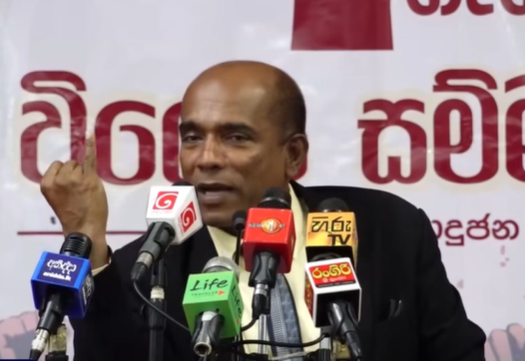

Attorney-at-Law Sanjeewa Weerawickrama questioned the legal grounds for detaining several high-profile individuals under the Prevention of Terrorism Act (PTA), challenging authorities to specify the acts of terrorism allegedly committed by those held under executive detention orders.
Speaking at the ‘Yukthiya Wenuwen Nagitimu’ (Stand Up for Justice) seminar organised by the Sri Lanka Podujana Peramuna (SLPP), Weerawickrama asserted that a person could lawfully be arrested under counter-terrorism legislation only if an actual terrorist act had been committed.
He questioned what specific acts of terrorism had been committed by Kehelbaddara Padme and Sewwandi. He raised the same question regarding Nadun Chinthaka, alias ‘Harak Kata’, and General Suresh Sallay.
Referring to former Chief Minister Sivanesathurai Santhirakanthan, alias ‘Pillayan’, Weerawickrama urged those examining the case to inspect the official B-report submitted when Pillayan was produced before court to determine whether he had been charged over an actual terrorist act.
Weerawickrama reiterated that detaining an individual for terrorist activities required the commission of a terrorist offence. He said that, despite this requirement, Pillayan had been held for one year and Sallay for eight months.
Addressing amendments to counter-terrorism legislation, he said that while the international community had called for a more humane legal framework, the revisions had instead expanded police powers.
He stated that police were now permitted to detain suspects for up to 48 hours without informing the court, doubling the previous 24-hour limit.