
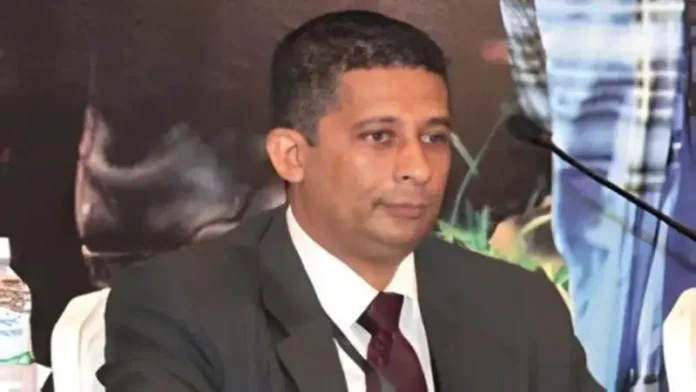

The Colombo Fort Magistrate’s Court ordered that notice be issued on the Director of the National Hospital of Sri Lanka to appear before court on 22 September and explain the failure to submit medical reports on former State Intelligence Service Director Suresh Sallay, who remains hospitalised.
Colombo Fort Magistrate Pasan Amarasinghe issued the order when the case was taken up on 15 September, following a request by Additional Solicitor General Dileepa Peiris, who appeared for the prosecution.
The Magistrate also directed the Hospital Director to explain why information requested by a five-member medical board appointed by the court to assess Sallay’s health had not been provided.
‘A major medical conspiracy’
Peiris told court that on 2 September, the National Hospital Director had been ordered to report whether Sallay required inpatient treatment. However, the report had not yet been received.
He said Criminal Investigation Department officers who inquired about the matter had been informed that the report could not be handed to them and would instead be sent directly to court. Nevertheless, it had still not been submitted.
“There is a major medical conspiracy here,” Peiris alleged.
He claimed that even heart transplant patients generally remained hospitalised for only 10 to 15 days, while Sallay had been in hospital for nearly 100 days.
Peiris said Sallay had undergone procedures such as dental fillings and ear cleaning and had only been fitted with a device to regulate his heartbeat, which he argued was not a major surgical procedure.
He alleged that Sallay remained hospitalised for two reasons: to obstruct the investigation and to protect individuals above him.
Peiris further claimed that Sallay had previously attempted to avoid arrest by submitting a psychiatric report and later began a hunger strike three days after travel bans were imposed on his alleged superiors.
“The suspect has turned the hospital into his rest house,” he alleged, requesting a comprehensive report on Sallay’s health.
Military intelligence accused of ignoring advance warning
Reporting on the progress of the Easter Sunday attacks investigation, Peiris alleged that members of the Military Intelligence Corps had advance knowledge of the planned attacks but failed to take action.
He said the First Military Intelligence Corps operated from Vavuniya, while the Third Military Intelligence Corps operated from Girithale. He alleged that the Girithale camp had previously been linked to political killings and attacks.
According to Peiris, an informant known as “Thambiyan,” a former member of the LTTE who had also worked with Indian intelligence agencies, provided information to the Military Intelligence Corps.
He said Corporal Suranga handled the informant, while Colonel Ranaweera was the officer above him.
Peiris alleged that Thambiyan had provided Corporal Suranga with information about Zahran Hashim’s activities, but that the intelligence was not passed to then Director of Military Intelligence Chula Kodituwakku.
He further claimed that the informant warned Military Intelligence on the day before the Easter Sunday attacks that an assault was planned for the following day, but no action was taken.
“The Military Intelligence authorities could have discussed the information with the Police or the CID and taken further action. Instead, they remained silent and allowed the attacks to take place. Had they acted immediately, the attacks could have been prevented,” Peiris told court.
Allegations involving Rishad Bathiudeen and businessman Alawdeen
Peiris also referred to politician Rishad Bathiudeen and a businessman identified as Alawdeen.
He said Alawdeen was the father-in-law of Easter Sunday suicide bomber Inshaf Ahmed. Following the attacks, Alawdeen’s daughter had allegedly been arrested by the CID and detained under a detention order.
However, Peiris claimed that she was released following Gotabaya Rajapaksa’s election as President in 2019.
He alleged that Sallay had been appointed SIS Director to facilitate such actions and claimed that Sallay had concealed information about Zahran while arresting only lower-level individuals.
Peiris further alleged that investigations had revealed that Zahran and his followers had travelled between Sri Lanka and India on several occasions using high-speed boats owned by Alawdeen.
He claimed that Alawdeen had assisted Zahran’s group, while Bathiudeen had provided political protection. These claims were presented in court as part of the prosecution’s submissions and have not been judicially established.
Further probe into Sainthamaruthu deaths
Peiris also raised concerns over the deaths of 16 people at a house in Sainthamaruthu five days after the Easter Sunday attacks.
He claimed that the deaths resulted from an attack carried out by the Army and argued that those inside could have been captured alive.
Questions had therefore arisen as to why all the individuals had been killed, he said.
Peiris added that a journalist named Niyas, who had reportedly gone to obtain information about the incident, had also died. He said further investigations would be conducted, noting that the area had been under military control in the Eastern Province.
Travel ban sought against intelligence officer
Peiris also sought a travel ban against Police Inspector Ranjan Senarath Bandara, who had been in charge of a unit within the SIS responsible for investigating extremist activities.
He told court that then SIS Director Nilantha Jayawardena had received information from a foreign intelligence service on 3 April 2019 warning of an impending terrorist attack.
Jayawardena had reportedly passed the information to Senior Superintendent of Police Mallawarachchi, who subsequently assigned it to Bandara for further action.
Peiris said Bandara then travelled to the Eastern Province and met a man known as “Seini,” Zahran’s younger brother, who was later killed in the Sainthamaruthu incident.
He argued that the Easter Sunday attacks could have been prevented had Bandara arrested Seini during that meeting.
“Instead, he merely met Seini, spoke with him, had tea and returned,” Peiris alleged.
Citing concerns that Bandara could leave the country, Peiris requested an order preventing him from travelling overseas.
Defence rejects prosecution’s allegations
President’s Counsel Shavindra Fernando, appearing for Sallay with Attorney-at-Law Asith Siriwardena, rejected the prosecution’s submissions.
“Any falsehood can be included in a B report, but that does not make it evidence,” Fernando said.
He argued that although the Additional Solicitor General had made lengthy submissions, no material directly connecting Sallay to the allegations had been presented.
“The submissions merely claimed that my client’s subordinates had committed these acts,” he said.
Fernando noted that the court had ordered medical authorities—not Sallay’s legal team—to submit reports on his client’s health.
He also sarcastically remarked that he did not possess the Additional Solicitor General’s apparent knowledge of medicine, as neither the Sri Lanka Law College nor the Attorney General’s Department had provided medical training.
The Magistrate observed that the court-appointed five-member medical board had requested information from the National Hospital to prepare its report. However, the board had reportedly been informed that any such request should be made through court.
The case was fixed for 22 September.