
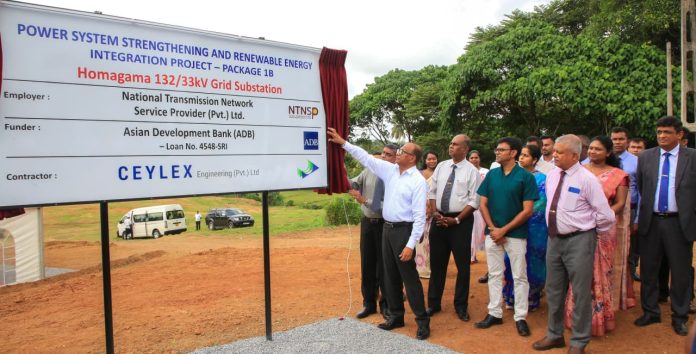


Sri Lanka has launched a USD 328.25 million project to modernise its electricity transmission network, accommodate renewable energy generation and improve the reliability of the national power system.
The Power System Strengthening and Renewable Energy Integration Project (PSSREIP) was officially launched on Thursday (13), with construction beginning on a new 132/33 kV grid substation in Homagama.
The project, financed through a concessional facility from the Asian Development Bank (ADB), will be implemented by Lanka Electricity Company (LECO), National Transmission Network Services Provider (NTNSP) (Pvt) Ltd and National System Operator (NSO) (Pvt) Ltd.
The construction launch was held under the patronage of Ports, Civil Aviation and Energy Minister Anura Karunathilaka.
The Homagama substation is expected to meet rising industrial and commercial electricity demand in Homagama, Kottawa, Malabe and Horana. It will also ease the pressure on the Pannipitiya and Kosgama substations, which currently supply electricity to these areas.
Under another component of the project, a 132/33 kV grid substation will be constructed in Negombo to meet increasing demand generated by tourism and industrial development. It will also provide additional electricity capacity for the expansion of Bandaranaike International Airport and the proposed Aero City project.
Construction of the Homagama and Negombo substations is scheduled to be completed within two years.
The project is expected to strengthen the national grid, improve security of supply and operational stability, reduce voltage-related issues and create the transmission capacity required to integrate future renewable energy generation.
Further plans include constructing a 220/33 kV grid substation in Mirigama and a 132/33 kV substation in Peliyagoda, along with a 78-kilometre, 132 kV double-circuit transmission line from Hambantota to Matara.
A two-kilometre underground transmission line will also connect the Kelaniya–Kotugoda transmission line to the proposed Peliyagoda substation using a Line-In Line-Out connection.
Meanwhile, construction of a 220 kV underground transmission cable system from Kerawalapitiya to the Colombo Port commenced last week.