
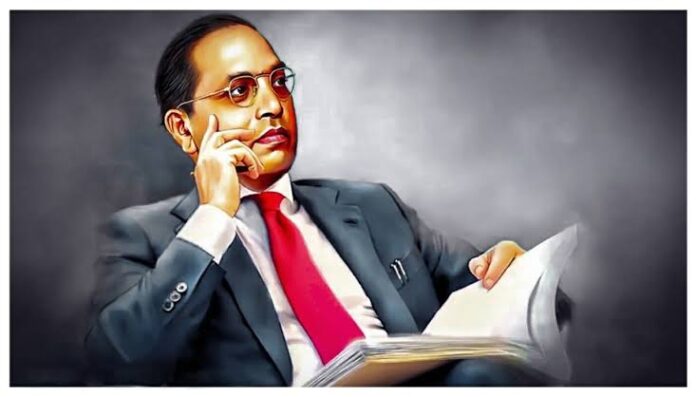

By Dr. Damenda Porage
Leadership rarely emerges from comfort. More often, it takes shape when someone decides that the quiet indignities they endured in silence will end with their generation. Long before Dr. Bhimrao Ramji Ambedkar helped forge modern India, he was an outcast child forced to sit on a burlap sack in the dust outside his schoolroom, forbidden from touching the water pitcher that nourished every other student. In a system built to crush any sense of personal worth, most would have broken. Ambedkar took every humiliation, transformed it into intellectual discipline, and built a life that systematically dismantled the social hierarchy that tried to keep him down.
Knowledge as a Weapon of Self-Reliance
Ambedkar realized early that sympathy would never alter his reality, only absolute mastery of knowledge could. His academic journey stands as one of the most remarkable accomplishments of the twentieth century. Supported by a few insightful benefactors who recognized his formidable intellect, he traveled abroad to pursue higher studies. He earned advanced degrees and doctorates from Columbia University in New York and the London School of Economics, while simultaneously qualifying for the Bar at Gray’s Inn in London.
In an era when basic human dignity was denied to him in his own homeland, his academic brilliance forced the international scholarly world to pay attention. Yet he never viewed education as a quiet retreat or a credential to parade. He saw it as a sharp, practical instrument for social reconstruction. This transformative power of state-supported learning remains a living reality across South Asia today; Sri Lanka’s own President, Anura Kumara Dissanayake, stands as a prime example, rising from humble, non-aristocratic beginnings through free education, sheer perseverance, and dedication to lead the nation.
His famous call, “Educate, Agitate, Organize”, was not an invitation to chaotic protest, but a sober blueprint for self-elevation. For Ambedkar, an uncultivated mind remains easily manipulated, whereas an educated mind, trained in critical thought and moral clarity, becomes an unshakeable force against institutional unfairness.
Building a Framework for Human Dignity
When colonial rule ended in 1947, India faced the daunting task of stitching together a vast, deeply divided society. Appointed Chairman of the Constitution Drafting Committee and serving as the nation’s first Law Minister, Ambedkar took on the responsibility of writing the supreme law of the land.
He refused to draft a mere collection of administrative rules. Instead, he crafted a living document anchored in liberty, equality, and fraternity, values he insisted were not borrowed from Western political thought, but were deeply rooted in ancient Indian tradition, particularly the teachings of the Buddha.
He understood that political democracy remains hollow if social and economic equality are missing. By enshrining fundamental rights, outlawing untouchability, and establishing clear legal protections for women and minorities, he created a constitutional morality that placed individual dignity above entrenched prejudice. His work laid down a lasting standard: no nation can claim to be free while millions of its people remain second-class within its borders.
Reclaiming the Dhamma
For Ambedkar, legal reforms and political guarantees were essential, but they could never be complete without a moral foundation. Real freedom, he argued, required an inner transformation that restored self-respect to the human spirit.
After years of studying world religions, Ambedkar found the clearest expression of reason, human equality, and active goodwill in the teachings of Sakyamuni Buddha. Dr. Ambedkar’s deep bond with Sri Lanka is further highlighted by his historic visit to Ceylon in May 1950 to attend the inaugural World Fellowship of Buddhists conference organized by Dr. G. P. Malalasekera. During his stay, as India’s Law Minister, he traveled across the island to observe Buddhist traditions, monastic practices, and living heritage firsthand, an experience that deeply influenced his vision for reviving the Buddha Dhamma in India, which culminated six years later in his monumental 1956 Mass Conversion in Nagpur.
On 14 October 1956, at Deekshabhoomi in Nagpur, he publicly embraced the Buddha Dhamma alongside more than half a million followers. This was not a simple change of religious affiliation; it was a profound socio-spiritual reclamation. By bringing the Dhamma back to the land of its birth, Ambedkar stripped away centuries of dogma and caste discrimination. He presented the Buddha’s message not as a secluded, ascetic escape from daily life, but as an active, rational ethic capable of guiding modern human relationships toward mutual respect. In doing so, he re-established a civilizational link that reconnected India with the broader Buddhist world, including Sri Lanka.
Parallel Flair – Anagarika Dharmapala and Dr. Ambedkar
The historic bond between Sri Lanka and India finds one of its strongest expressions in the shared spirit of Anagarika Dharmapala and Dr. B. R. Ambedkar. Though working in different settings and eras, both men shared a single conviction: using the timeless principles of the Buddha Dhamma to awaken and uplift their people.
Anagarika Dharmapala traveled across continents to restore sacred Buddhist sites in India and re-awaken Sri Lanka’s cultural consciousness during an era of colonial suppression. Decades later, Dr. Ambedkar carried out a complementary mission, reviving the Dhamma as a force for social justice and human emancipation within India. Both leaders recognized that the Buddha’s teachings were never meant to be confined to ancient manuscripts, but were meant to serve as a dynamic guide for ethical living and social renewal.
Under the Maitri Setu initiative in Biyagama, where 15-foot statues of these two figures will stand side-by-side, we honor this shared legacy. This memorial is more than a gesture in stone and bronze; it is a physical meeting point for two historical movements that drew from the same ancient wisdom to solve modern human crises.
What Ambedkar’s Legacy Demands of Today’s Youth
As Sri Lanka works through its own social and economic challenges, Ambedkar’s life offers a clear, steady compass for the rising generation. Progress does not come from waiting for better circumstances, nor does it depend on political slogans, but on disciplined self-study, moral courage, and an uncompromising commitment to the truth. For today’s youth, this means committing to deep scholarship to understand complex issues, standing up for constitutional values and human dignity, and cultivating personal character alongside intellect. True fulfillment is found when individual talent is directed outward to lift up others. Dr. B. R. Ambedkar demonstrated that a single person, armed with knowledge, integrity, and persistent effort, can alter the trajectory of a nation.
As we honor his memory alongside that of Anagarika Dharmapala, his message to young people remains entirely relevant: sharpen your mind, stand firm in moral purpose, and use what you learn to build a fairer world