
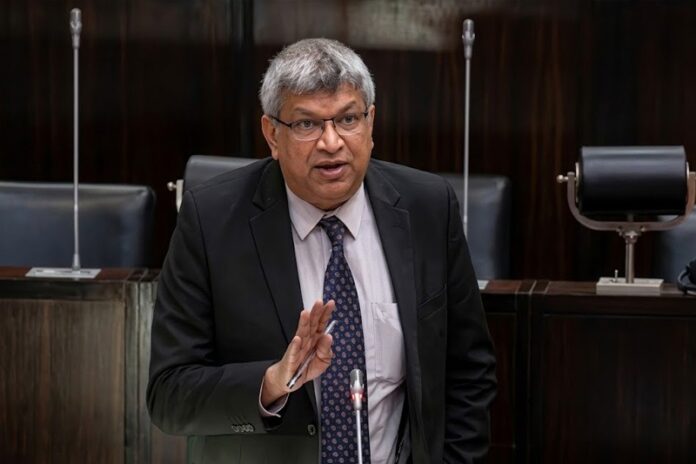

Justice Minister Harshana Nanayakkara has dismissed claims that the proposed Prevention of Organised Crimes Bill would allow individuals to be arrested over their hairstyles, tattoos or clothing, stressing that the legislation does not even contain the word “hair”.
Addressing Parliament today (20), the Minister accused certain groups of spreading false and misleading information on social media, creating unnecessary fear among the public that people with long hair or tattoos could be treated as criminals under the proposed law.
Explaining Section 4(2)(c) of the Bill, Nanayakkara said distinctive hand gestures, symbols and tattoos commonly associated with known organised criminal groups could be considered when determining whether an individual was a member of such a group.
However, he emphasised that these characteristics would only constitute a rebuttable presumption of membership in an organised criminal group and would not, by themselves, establish criminal liability.
The Minister said the provision was based on internationally recognised approaches to identifying organised criminal groups, including those reflected in Singapore’s organised crime legislation.
He maintained that the proposed legislation, aimed at combating organised crime, drug trafficking and murder, would not interfere with individuals’ freedom of personal expression or fundamental rights.
“Wearing clothes of your choice, getting a tattoo or having a hairstyle you prefer are fundamental rights,” the Minister said.
Nanayakkara further stated that anyone with concerns about the constitutionality of the proposed legislation could challenge it before the Supreme Court instead of spreading what he described as misinformation.
The Minister’s remarks came amid criticism of the proposed legislation, particularly concerns that physical appearance, including tattoos and clothing, could be used to identify individuals as members of organised criminal groups.
The Bill was presented to Parliament for its first reading today (20).