

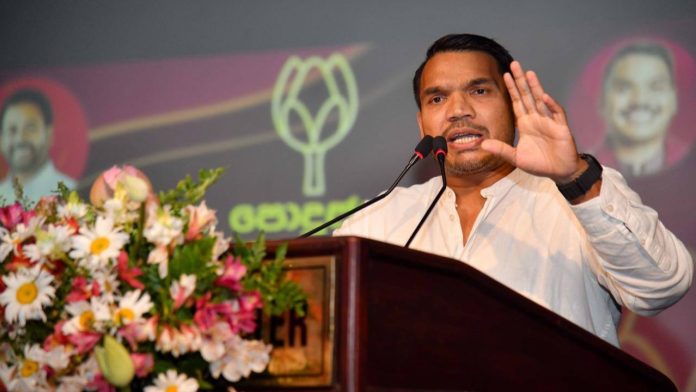

“Rajapaksa politics never had racism in it,” Sri Lanka Podujana Peramuna (SLPP) National Organiser and MP Namal Rajapaksa said yesterday, insisting that neither the Rajapaksa tradition nor the SLPP had engaged in racist politics. He added that his faction had always stood for what it believed to be right, irrespective of ethnic or religious identity.
Speaking to journalists at Nelum Mawatha, Rajapaksa accused the present Government of attempting to create divisions among communities while using State institutions for political ends. He claimed the administration was trying to intimidate the Attorney General’s Department and the judiciary, but said he was confident that both institutions would not yield to political pressure. Rajapaksa remarked that the Government “may have passed Grade 5, but has failed its sixth year.”
He went on to criticise the President’s political approach, alleging that it revolved around provoking confrontation. “According to the President’s method, now you cannot even go to Nagadeepa to worship, and people from Jaffna cannot come to the South to celebrate Pongal. That is the President’s political theory,” he said, adding that the President was attempting to apply the same tactic against ethnic groups that he had previously used against political parties, institutions, officials, and chairpersons.
Rajapaksa said the President had nothing substantive to tell the people of Jaffna unless he could at minimum assure the protection of Tamil cultural heritage or create a credible plan to advance it. He stressed that “this type of politics is no longer valid.”
Rejecting allegations of racism against the Rajapaksas or the SLPP, Rajapaksa said the previous administration had defended religious rights without discrimination. “Our stance was not for a temple, or a kovil, or a Catholic church, or a mosque. It was for what was right,” he said, pointing to the end of the war and the restoration of religious activities in Madhu and freedom of worship at the Mullaitivu kovil during their tenure.
He charged that some political actors resorted to accusing others simply to bury real issues.