
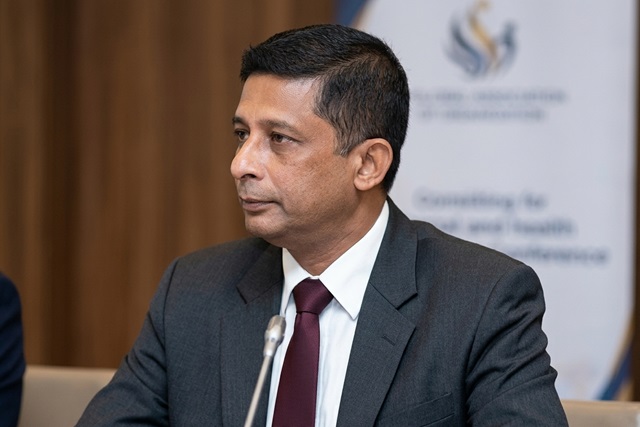


Former State Intelligence Service Director Major General Suresh Sallay has launched a hunger strike in Criminal Investigation Department (CID) custody with the intention of fasting to death, according to Pivithuru Hela Urumaya leader Udaya Gammanpila.
Addressing a special media briefing yesterday (6), Gammanpila said Sallay had commenced the hunger strike on Thursday night in protest against what he described as inhumane treatment while in detention.
He appealed to Sallay to immediately end the hunger strike and safeguard his life.
Gammanpila said the media briefing was convened following an urgent request by Sallay’s wife and son. He further claimed that Sallay’s detention was not based on a court order but on a detention order issued by the President under the Prevention of Terrorism Act (PTA), which he alleged amounted to an abuse of power. He added that the detention order had already been challenged before court.
According to Gammanpila, Sallay’s brother and son visited the CID on Friday morning and found him in a severely distressed mental state.
He alleged that Sallay had been served a meal consisting only of a spoonful of rice and radish curry placed on a newspaper spread on the floor. When he attempted to pick up the food, the newspaper reportedly tore, causing the food to fall to the ground, which he was then forced to eat.
Gammanpila claimed the incident had left Sallay deeply traumatised, prompting him to break down in tears and complain that he was being treated worse than a dog. He said Sallay had subsequently refused food, water, and medication and embarked on a fast unto death.
He also alleged that seven police officers had been assigned as witnesses to monitor conversations during family visits.
Drawing a comparison with past investigations, Gammanpila said former CID Director Shani Abeysekara had once cited a shortage of officers as a reason for failing to arrest Easter Sunday attacks mastermind Zahran Hashim, yet the CID now appeared to have sufficient personnel to deploy seven officers to listen to a conversation between Sallay and his son.
Citing a medical report submitted to the Colombo Fort Magistrate’s Court by the National Institute of Forensic Medicine and Toxicology, Gammanpila said doctors had identified Sallay as being at high risk of self-harm.
He said the report indicated that Sallay was suffering from severe protein, vitamin, and Vitamin B12 deficiencies and that doctors had recommended daily exposure to sunlight and opportunities for exercise.
Gammanpila further alleged that seven days after his arrest, Sallay had been stripped naked, handcuffed, bent forward, and subjected to an anal examination in front of three other suspects, describing the act as sexual torture. He claimed these details were contained in the official medical report.
He also alleged that Sallay had been forced to sleep on the floor for 40 days, kept under bright lights operating 24 hours a day, confined to a four-foot room, and made to urinate into a tin container inside the cell.
Challenging the CID to refute the allegations, Gammanpila called on authorities to release security camera footage if the claims were false.
He further alleged that the Government, which came to power on what he described as false accusations related to the Easter Sunday attacks, had failed to uncover evidence after two years of investigations and was now facing difficulties in pursuing the case.
Gammanpila said there were suspicions of a conspiracy whereby, if Sallay were to die during the hunger strike, authorities could claim that any secrets died with him.
He concluded by urging Sallay to abandon the hunger strike, remain alive, and prove his innocence through legal means.