
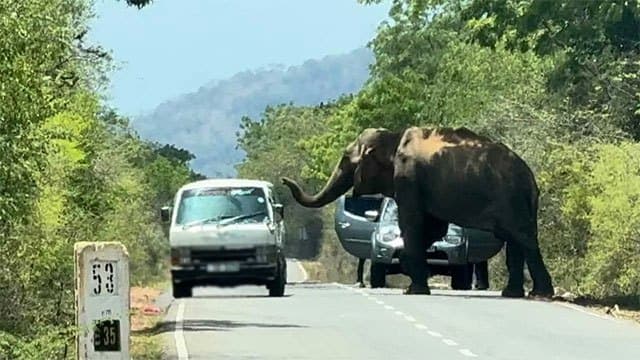

The Department of Wildlife Conservation has decided to take legal action against motorists who feed wild elephants along the Kataragama–Buttala Road, following a series of elephant attacks that have resulted in deaths, injuries and extensive damage to vehicles.
Wildlife officials said that approximately eight wild elephants had become accustomed to stopping vehicles and seeking food from motorists, posing a serious threat to road users.
More than 2,000 vehicles use the road daily, including those transporting pilgrims to Kataragama and passengers travelling to Monaragala, Wellawaya and Bandarawela.
According to wildlife officials, elephants accustomed to receiving food from passing vehicles have become aggressive when food is not provided. Several incidents have been reported in which elephants attacked vehicles or attempted to overturn them.
In a recent incident, an elephant attacked a bus, causing it to overturn and injuring approximately 40 people.
Wildlife officials further revealed that elephant attacks on vehicles along the road had claimed the lives of five people, including three women and two men, over the past six years.
They added that more than 100 vehicles were damaged annually as a result of such attacks.
The Department emphasised that although motorists were permitted to travel along the road, which passes through Block 2 of Yala National Park, getting out of vehicles and feeding wild animals was illegal.
Officials pointed out that during the COVID-19 pandemic, when vehicle movements were restricted, elephants had not gathered along the road and had instead relied on natural food sources within the forest.
However, the practice of feeding elephants by motorists, including bus and safari jeep drivers, had gradually conditioned the animals to remain near the road in search of food.
Uva Province Assistant Director of Wildlife Conservation W.A. Indrajith said the Department would video-record vehicles whose occupants fed wild elephants and initiate legal proceedings against those responsible.
He explained that legal action would be taken under the Fauna and Flora Protection Ordinance on charges relating to the harassment of wild animals.