
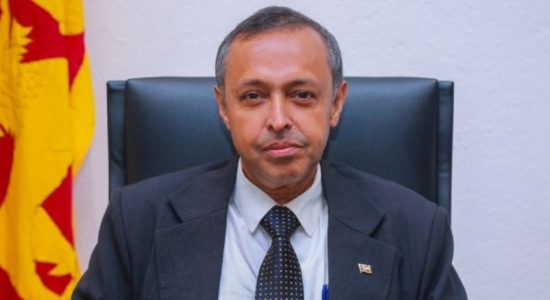


Transport, Highways and Urban Development Ministry Secretary Prof. Kapila Perera has reportedly decided to step down from his post.
Sources said Prof. Perera had formally informed the Ministry of Public Administration, Provincial Councils and Local Government of his decision to resign from the Secretary position. President Anura Kumara Dissanayake has also reportedly been informed of the decision.
Following his departure from the Ministry, Prof. Perera is expected to return to university service. He previously served as Vice Chancellor of the University of Moratuwa.
The reported decision comes days after the Supreme Court ruled that Prof. Perera had violated the fundamental rights of a senior public official by obstructing him from performing duties as an Additional Secretary at the Ministry.
In a judgment delivered on 19 May, the Supreme Court held that Prof. Perera, as Secretary to the then Ministry of Transport, Highways, Ports and Civil Aviation, had infringed the fundamental rights of W.S. Sathyananda, a Special Grade officer of the Sri Lanka Administrative Service.
The ruling followed an extended hearing into a fundamental rights petition filed by Sathyananda, who challenged the treatment he faced after being appointed Additional Secretary to the Ministry.
The judgment was delivered by Supreme Court Justice Arjuna Obeyesekere, with the concurrence of Justices Sobitha Rajakaruna and Janak de Silva.
According to the petitioner, he had nearly 30 years of experience in the public service and had been appointed Additional Secretary to the Ministry by an official letter issued by the Ministry of Public Administration on 18 December 2024. He had reported for duty on the same day.
Sathyananda told Court that at around 12:30 p.m. on the day he assumed duties, Prof. Perera entered his office room and informed him that his services were not required at the Ministry and instructed him to leave immediately.
The petitioner argued that the conduct of the Ministry Secretary towards a senior public official had caused him humiliation and severe mental distress, and amounted to an arbitrary violation of his fundamental rights.
Delivering the judgment, Justice Obeyesekere noted that under Rule 107 of the Public Service Commission Rules, published in Extraordinary Gazette No. 2310/29 dated 14 December 2022, the authority to appoint an Additional Secretary rests exclusively with the Public Service Commission (PSC).
The Court further observed that Rule 61 of the same regulations provides that any person who directly or indirectly attempts to influence or obstruct a decision of the PSC or one of its committees, other than in the lawful discharge of duties, commits an offence punishable by a fine of up to Rs. 100,000, imprisonment of up to seven years, or both.
The Supreme Court concluded that by interfering with a lawful appointment made by the PSC, the Ministry Secretary had seriously undermined the rule of law and breached the public trust placed in him.
The Court emphasised that public officials are custodians of public trust and are expected to exercise their powers responsibly and in accordance with the law. It further stressed that supervisory authority vested in a Ministry Secretary does not permit attempts to appropriate the constitutional powers granted to the PSC in matters relating to appointments and transfers.
The Court ultimately found that the respondent Secretary had deprived the petitioner of the dignity due to him as both a person and a public officer, and unanimously ruled that the petitioner’s fundamental right to equal protection of the law under Article 12(1) of the Constitution had been violated.