
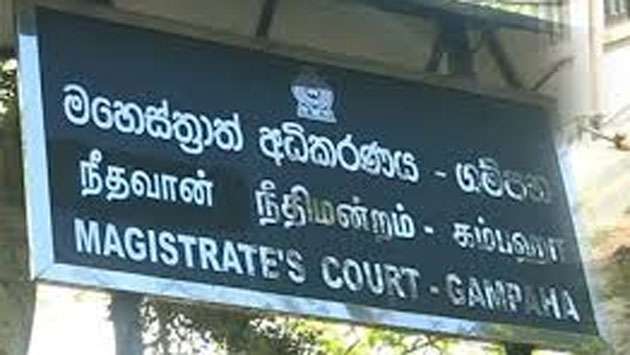


The Gampaha Magistrate’s Court has ordered the Police Department and three police officers attached to the Gampaha Anti-Corruption Unit to pay Rs. 200,000 in compensation to a man who was prosecuted based on allegedly fabricated drug charges.
Delivering the order, Gampaha Magistrate Bandula Gunaratne warned that if police continued pursuing higher case numbers merely to satisfy targets imposed by senior officers, Sri Lanka’s population itself would eventually become insufficient for police to file cases against.
The Magistrate held that the police had instituted a vexatious prosecution that caused undue hardship to a citizen.
He further directed the Court Registrar to forward a copy of the order to the Inspector General of Police (IGP).
The compensation order was issued after the Magistrate acquitted Devalapola resident Chamara Chathuranga Marasinghe from two narcotics cases filed against him by the Gampaha Anti-Corruption Division.
Police had alleged that on or around 6 May 2026, at the Asgiriya Junction in Gampaha, Marasinghe was found in possession of 130 mg of “ice” and 500 mg of heroin. The Officer-in-Charge of the Gampaha Anti-Corruption Unit had filed charges, naming a police sergeant and a constable attached to the unit as witnesses.
However, when one of the narcotics cases was called, Marasinghe pleaded guilty and was fined. Shortly afterwards, a second case involving the same accused and the same offence was called before court.
Observing that two separate cases had been filed against the same individual on the same day for the same offence, Magistrate Gunaratne summoned the relevant witnesses and senior officers to explain why action should not be initiated against them under Section 17(1) of the Code of Criminal Procedure for instituting oppressive proceedings. None of the officers appeared before court.
During proceedings, the police sergeant appearing for the complainant stated that 16 individuals had been arrested during the same raid and that the charges against the accused had been filed in error. Police sought permission to withdraw one case and continue with the other.
Rejecting the request, the Magistrate stressed that police raids should be conducted on the basis of evidence capable of establishing guilt before a court of law.
The Court noted that naming three police officers as witnesses in the case indicated an apparent intention to secure a conviction against the accused through prosecution, and held that the police request could not be accepted.
The Magistrate also raised broader concerns regarding narcotics prosecutions, observing that although police frequently filed large numbers of drug-related cases, Government Analyst reports often revealed significantly smaller quantities of narcotics than initially claimed by police, while some exhibits contained no narcotics at all.
He further criticised the manner in which police implemented instructions to increase narcotics detections, stating that evaluating police performance by demanding a higher number of cases each month was fundamentally flawed.
“If crime detection genuinely reflected police efficiency, the number of cases in a given area should decrease over time, not increase,” the Magistrate observed, adding that a rise in case numbers in a police division was, in reality, evidence of inefficiency.
The Court further warned that if senior officers continued ordering junior officers to surpass previous months’ case numbers, within five years the country’s population may not be sufficient for police to prosecute.
Magistrate Gunaratne also observed that police, at times, appeared to use Section 54 of the Poisons, Opium and Dangerous Drugs Ordinance as a means of limiting judicial discretion, warning that such practices risked eroding the judiciary’s trust in police officers.
He stressed that senior police leadership should immediately review and reform the existing system.
The Court noted that despite the Gampaha Senior Superintendent of Police being summoned to address these concerns, he had failed to appear, reflecting what the Magistrate described as a serious disregard for court proceedings.
Finding that police had failed to provide sufficient justification as to why action should not be taken under Section 17(1) of the Code of Criminal Procedure, the Magistrate ordered the three officers named as witnesses in the two cases to pay Rs. 25,000 each in compensation to the accused.
The Court further ruled that the Police Reward Fund — which receives a substantial share of fines collected under drug laws — should also be utilised in instances involving baseless prosecutions.
Accordingly, the Magistrate ordered Rs. 50,000 compensation per case, amounting to Rs. 100,000 across the two cases, and directed that a copy of the order be sent to the IGP.
The Magistrate said the ruling was intended to draw attention to problematic policing practices, while emphasising that the officers concerned should not face disciplinary action unless accountability also extended to senior officers who had instructed such enforcement practices.