
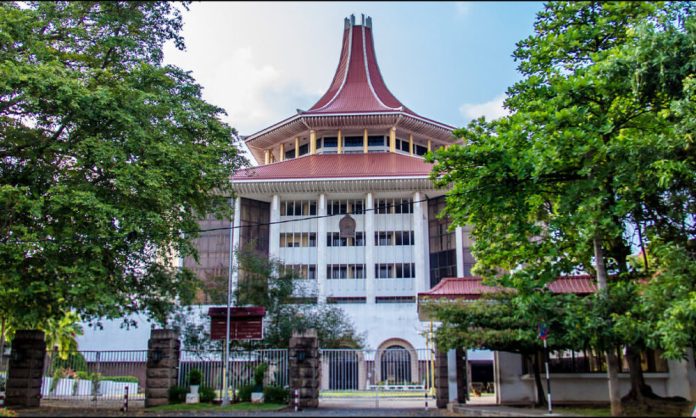


The Supreme Court has ruled that the fundamental rights of a lawyer were violated after the then Acting Officer-in-Charge (OIC) of the Welimada Police verbally abused him and failed to treat him with dignity when he visited the police station in 2016 to carry out his professional duties.
The ruling was delivered after hearing a fundamental rights petition filed by Attorney-at-Law R.M. Sajith Bandara against the police inspector who was serving as the Acting OIC of the Welimada Police at the time of the incident.
The judgment was delivered by Supreme Court Justice Arjuna Obeysekera, with Justices Sampath Abeykoon and Gihan Kulatunga concurring.
The case stemmed from an incident on February 22, 2016, when a complaint was lodged alleging that several electricity poles belonging to the Ceylon Electricity Board had been stolen by a group that arrived in an Army lorry.
Several Army personnel were subsequently arrested and produced at an identification parade, but witnesses failed to identify them.
Thereafter, Attorney-at-Law Bandara accompanied another group of Army officers to meet the Acting OIC at the Welimada Police Station. According to the petition, the officer, who was visibly angry, remarked that there was “no need for a man in a black coat” to be involved.
The lawyer then inquired whether the Army officers were required as suspects or whether the police merely intended to record their statements.
In response, the Acting OIC allegedly reffered to famouse Sinhala idiom, “If I want, I can turn a monitor lizard into a lizard and a lizard into a monitor lizard. (kabaragoya thalagoya karannath, thalagoya kabaragoya karannath puluwan),” implying that he had the power to manipulate matters at his discretion.
Believing it was best to allow the officer to calm down, the lawyer left the office and later filed the fundamental rights petition.
Delivering the judgment, Justice Obeysekera emphasised that any citizen may have to visit a police station as a complainant, witness, or suspect.
He further observed that police officers exercise powers entrusted to them by the public for the enforcement of the law and must therefore treat every individual who comes to a police station with dignity and respect.