
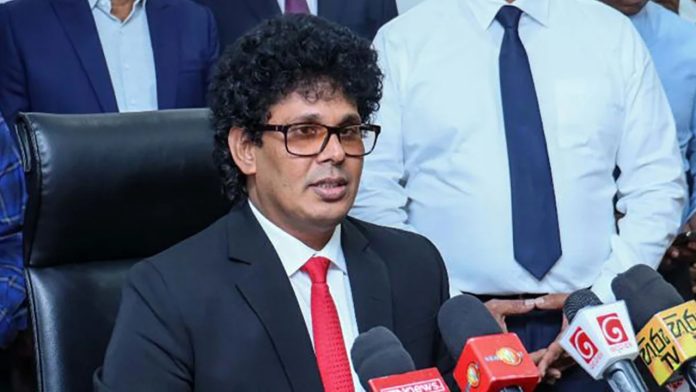


Minister Wasantha Samarasinghe has dismissed claims circulated by the opposition and sections of the media that it plans to provide rice to public servants under a “leasing” scheme, stating that the programme is intended to clear paddy stocks and ensure farmers receive a fair price for the upcoming harvest.
Addressing a media briefing, Minister of Trade, Commerce, Food Security and Cooperative Development Wasantha Samarasinghe said Sri Lanka produced 5.03 million metric tonnes of paddy in 2025, equivalent to around 3.2 million metric tonnes of rice. With the country’s annual rice consumption standing at approximately 2.4 million metric tonnes, he said there is a surplus of about 800,000 metric tonnes.
The Minister recalled that rice millers had previously increased the price of Keeri Samba rice to around Rs. 400 per kilogram after its harvest declined to six percent of total production. He said the government intervened by introducing substitute rice varieties such as Keeri Ponni and GR11, bringing prices down to between Rs. 230 and Rs. 255 per kilogram.
Samarasinghe said the government’s immediate challenge is the lack of storage space to purchase paddy from the forthcoming Yala harvest.
“We have decided to convert half of the 120,000 metric tonnes of paddy held by the Paddy Marketing Board into rice through a tender process and distribute it through Sathosa and cooperative outlets. This is not a leasing scheme. It is a measure to clear storage facilities so that we can purchase the new harvest from farmers,” he said.
He noted that harvesting for the Yala season has already begun and stressed that the government will intervene to prevent farmers from being treated unfairly.
Accordingly, the government has allocated funds to purchase Nadu paddy at Rs. 120 per kilogram, Samba at Rs. 130 per kilogram, and Keeri Samba at Rs. 140 per kilogram.
The Minister appealed to the public to support the government’s programme, saying it is designed to manage the existing rice surplus, provide relief to consumers, and ensure farmers receive a fair price for their harvest.