
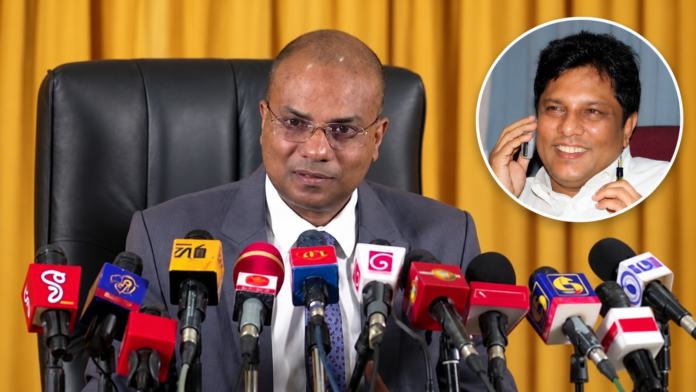

The Director General of the Commission to Investigate Allegations of Bribery or Corruption (CIABOC), Ranga Dissanayake, has called on Sri Lankans to support those who confront corruption while they are alive, saying society cannot continue to leave them to face threats alone and honour them only after their deaths.
Speaking at the launch of Kasun Pussewela’s Sinhala translation of Lasantha: Unbowed and Unafraid, a book by Raine Wickrematunge about her late husband, investigative journalist and the Editor of Sunday Leader Lasantha Wickrematunge, Dissanayake said the journalist’s killing had sent a warning to others who might challenge those in power.
Dissanayake said he had never met Lasantha, worked with him or practised journalism. He believed he had been invited to speak because his work at CIABOC and Lasantha’s reporting were connected by a shared opposition to corruption.
“Lasantha Wickrematunge was murdered because he directed his pen against corruption in Sri Lanka,” he said. “We have not definitively identified Lasantha’s killers—there are assumptions, but no conviction. However, the reason for his murder has been identified with complete certainty: his stand against corruption and fraud, especially by those in power.”
Dissanayake argued that the public’s failure to heed warnings about corruption had consequences far beyond the people who first exposed it. Recalling the shortages during Sri Lanka’s economic crisis, he asked whether those who had remained silent when Lasantha and others spoke out had not later suffered in queues for fuel and gas.
“The complete reason for this economic abyss is the bribery and fraud committed by those in power,” he said, referring also to the Supreme Court’s ruling on responsibility for the country’s economic collapse.
He said it was difficult to discuss such matters in polished, diplomatic language. In a society shaped by dishonesty, he argued, people needed to speak plainly about the pressure placed on those who refused to fall in line. Such people had an inner drive—that corrupt forces sought to suppress.
Dissanayake described attacks on people in several professions as warnings to their colleagues. Referring to Dr. Senaka Bibile, he suggested that those seeking to change practices in medicine faced pressure to stay quiet. He also spoke of the killing of customs officer Sujith Priyantha, saying it had frightened other officers and caused some to leave the country or withdraw from investigations. Acid attacks on auditors, he said, conveyed a similar message against challenging wrongdoing.
In journalism, he argued, Lasantha’s murder had warned reporters to limit themselves to routine coverage and avoid confronting the system.
“They killed Lasantha to tell journalists: ‘Go to politicians’ parties at night, write about politicians in the morning, report routine news, but don’t try to transform the system’,” Dissanayake said. “Our tragedy is that society absorbed that message completely.”
Turning to Lasantha’s relationships with political figures, Dissanayake said the book had revealed what he considered a vulnerability in the journalist’s life: treating politicians as personal friends.
“If Lasantha were to rise today and look at where those ‘friends’ now stand, he would realise where those politicians truly belonged,” he said. “A corrupt individual can never be a true friend to someone like Lasantha.”
He urged journalists to revisit recordings from 20 or 30 years ago and compare politicians’ positions then with their positions today.
Dissanayake cited an account in the book of a former President telephoning Lasantha and verbally abusing him. Lasantha subsequently wrote to the President and the Inspector General of Police about the call, Dissanayake said, but continued his work despite the danger he faced.
That danger had been apparent to Lasantha and to people around him, Dissanayake said. Others had warned the journalist that continuing his work could cost him his life, and Lasantha himself had acknowledged the possibility.
“Everyone knew it,” Dissanayake said. “Yet, everyone simply stood by and watched it happen. And after it all happened, they gather to commemorate him.”
Addressing the absence of convictions for Lasantha’s murder, Dissanayake drew on his experience as a judge to explain the distinction between what people may believe and what can be established in court. A court, he said, must decide whether the case against a particular accused person has been proved beyond reasonable doubt.
“Without secured evidence, a court cannot deliver justice,” he said. He argued that the failure to gather sufficient evidence had denied Lasantha justice through the courts, while those who knew the truth about the killing remained silent.
Dissanayake illustrated his wider point about public passivity with an incident from his days at Sri Lanka Law College. While travelling on a Route 177 bus from Kollupitiya towards Kaduwela, he said, he saw two youths harassing passengers who were trying to get off. When they attempted to assault an elderly passenger who questioned them, Dissanayake intervened while other passengers remained silent.
After the confrontation ended and the elderly man got off at Malabe, another passenger tapped Dissanayake on the shoulder and praised him, saying he too had wanted to confront the youths.
“If I had been beaten up, I would have suffered alone,” Dissanayake said. “That is our societal attitude: ‘You go get hanged; we won’t join you, but because you did it, you’re awesome.’ That is what must change.”
He said people had also questioned his decision to leave the judiciary to lead CIABOC, pointing to the criticism he now faced and the possibility that he could have risen further in his former career. Dissanayake attributed the decision to the same inner drive he saw in Lasantha and others who had challenged wrongdoing.
Concluding his address, he said Sri Lanka needed more people willing to take such stands, but also a society prepared to stand with them before it was too late.
“In our country, the hero always dies at the end,” he said. “The hero cannot die—the hero must win.”