
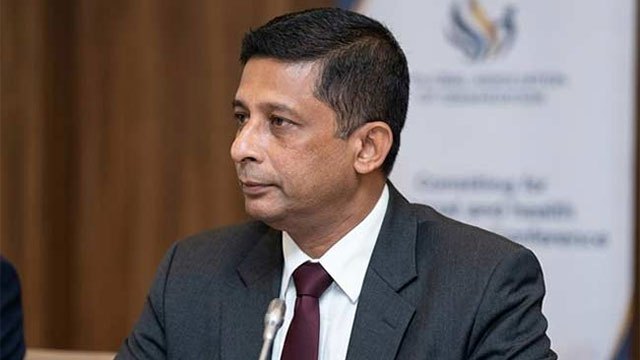

The Supreme Court today (25 September) dismissed a Fundamental Rights (FR) petition filed by retired Air Force officer Shantha Jayathilaka challenging the arrest and detention of former State Intelligence Service (SIS) Director Suresh Sallay under the Prevention of Terrorism Act (PTA) in connection with the Easter Sunday terrorist attacks.
The petition was dismissed without costs after the petitioner sought permission to withdraw it following preliminary submissions and questions raised by the court.
The order was issued by a two-judge Supreme Court bench comprising Chief Justice Preethi Padman Surasena and Justice Achala Wengappuli.
When the petition was taken up for consideration, Additional Solicitor General Sudarshana de Silva, appearing on behalf of the Attorney General, raised preliminary objections, arguing that the petitioner had no legal standing to institute Fundamental Rights proceedings on behalf of another individual.
He submitted that previous Supreme Court judgments did not permit the petitioner to file such an application on behalf of Sallay.
The Additional Solicitor General further informed the court that a writ petition had already been filed before the Court of Appeal on Sallay’s behalf and that the court had reserved its decision following preliminary consideration of that application.
He questioned how the petitioner could seek relief from the Supreme Court while proceedings concerning Sallay’s detention were already pending before the Court of Appeal.
He also argued that the petitioner had challenged a legal provision of the PTA, contrary to Article 80(3) of the Constitution. He maintained that such a matter could only be addressed by Parliament.
During the proceedings, Chief Justice Surasena questioned the petitioner on how Sallay’s arrest and detention had violated his own Fundamental Rights.
Responding, Jayathilaka claimed that Sallay had been unlawfully arrested and detained under the PTA and argued that such action also violated his Fundamental Rights as a citizen.
Justice Wengappuli questioned the petitioner’s legal standing to seek relief on behalf of another individual, particularly when Sallay himself had already sought legal remedies before the Court of Appeal.
The judge also asked whether the petitioner was personally facing any immediate risk of arrest.
Jayathilaka replied that he faced no such risk and explained that he had filed the petition as a public interest litigation application.
Justice Wengappuli observed that Sri Lankan law permitted public interest litigation only in very limited circumstances and that the concept could not be applied indiscriminately to every case.
He explained that the petitioner could seek judicial protection if he personally faced a threat of arrest but could not institute proceedings in the present circumstances to assert another individual’s rights.
In response to a further question from the Chief Justice, Jayathilaka informed the court that he had sustained a disability following a landmine explosion during the war and was receiving a pension.
Acknowledging his military service, Chief Justice Surasena said the court appreciated the petitioner’s contribution to the country.
However, the Chief Justice emphasised the importance of understanding the applicable legal framework, explaining that the petitioner did not have the legal standing to pursue the application on behalf of another person. He also cautioned that proceeding without a proper understanding of the law could expose the petitioner to difficulties.
Following the court’s observations, Jayathilaka requested permission to withdraw the petition.
The Supreme Court subsequently granted permission for its withdrawal and ordered that the petition be dismissed without costs.