
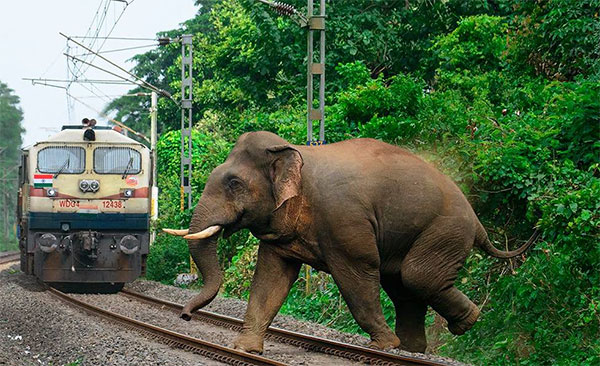


In the past 17 years, 138 elephants have been killed by trains on Sri Lanka’s railways with a single incident near Minneriya in February 2025 claiming seven lives, including four calves. University of Cambridge graduate Damsith Wimalasena is now developing an AI-powered detection system designed to prevent these collisions and stop the loss of life on rail tracks.
Damsith’s development, the Coexist Initiative, is designed to mount high-precision LiDAR sensors onto locomotive cockpits, detecting elephants at distances of up to 500 metres and providing operators with sufficient warning time to brake. The system plans to pair this hardware with machine learning algorithms that classify elephants in real time, while collected movement data is designed to help wildlife authorities map crossing patterns and inform conservation planning. The key attribute according to Damsith, lies in adapting proven automotive collision avoidance technology already deployed by car manufacturers for the railway context, significantly reducing development cost and deployment. The system is currently in the prototyping and development phase, drawing on best practices from automotive collision avoidance technology to inform its design.
The project won multiple awards including the University of Cambridge’s Lucy Cavendish College’s Enterprise Award and earned Wimalasena selection as a United Nations Millennium Fellow, a fellowship that accepted approximately five per cent of over 52,000 applicants from 170 countries. He also serves as a World Economic Forum Global Shaper and led Cambridge University Entrepreneurs, one of Europe’s largest student-run entrepreneurship communities. Lucy Cavendish College described Wimalasena as one of its ‘extraordinary students’, featuring his work in an official college profile and in the College’s Annual Review. As Sri Lanka’s elephant population reaches an estimated 7,451, with the human-elephant conflict claiming over 1,195 human and 3,484 animal lives in the past decade, the Coexist Initiative offers a technology-driven path toward coexistence.